

Illinois Childcare CPR Requirements: What Daycare Providers and Preschool Teachers Actually Need
If you work in childcare in Illinois — whether you run a licensed daycare center, teach preschool, work in a DCFS-licensed home, or staff a before-and-after-school program — you already know that CPR certification isn't optional. It's a licensing requirement. But the details of what counts, how often you need to renew, and which certification actually satisfies the state can get confusing fast, especially with so many CPR options floating around online.

We get calls about this constantly at Downers Grove CPR, usually from center directors trying to get their entire staff compliant before a licensing inspection, or from new hires who were told "you need a CPR card" with little more explanation. So let's clear it up.
Why Childcare CPR Requirements Exist in the First Place
Illinois' Department of Children and Family Services (DCFS) licenses child care centers, group homes, and family child care homes, and licensing standards require staff who supervise children to hold current CPR and first aid certification. The logic is straightforward: young children are more likely than adults to choke, and infants and toddlers require CPR techniques that are meaningfully different from what you'd use on an adult. A caregiver who's only trained on adult CPR isn't actually prepared for the population they're supervising.
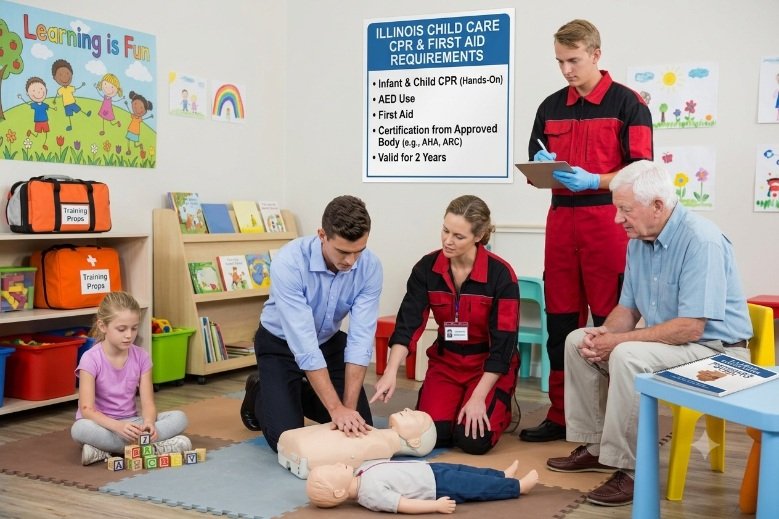
This is also why "any CPR class" doesn't automatically satisfy licensing requirements. Programs generally need to specifically include pediatric and infant CPR and choking response, not just adult compressions — and the certifying organization needs to be one DCFS recognizes, which in practice almost always means an American Heart Association or American Red Cross certification.
Which Certification Actually Meets the Requirement?
This is where we see the most confusion, so here's the short version:
For most classroom staff, assistant teachers, and family child care providers: Heartsaver Pediatric is typically the right fit. It's built specifically around infant and child CPR, pediatric choking response, and AED use for younger patients — which lines up with what licensing inspectors are actually looking for. It's also designed for people without a clinical background, so you're not sitting through content built for hospital staff.
For nurses, health consultants, or clinical staff working in a childcare or school health setting:
BLS Provider may be the more appropriate certification, since it's recognized across healthcare settings and covers team-based resuscitation skills that go beyond what a general Heartsaver course includes.

For center directors managing staff across an entire facility, it's worth having a mix — Heartsaver Pediatric for classroom-facing staff and potentially BLS for
staff with clinical responsibilities, like an on-site health aide.
One important note: a general adult-only Heartsaver CPR/AED card is usually not sufficient for licensed childcare roles, even though it meets many other workplace requirements. If your job involves directly supervising children, double-check that your certification specifically covers pediatric and infant response before assuming you're covered.
How Often Do You Need to Renew?
Most CPR and first aid certifications, including Heartsaver Pediatric, are valid for two years. Illinois licensing rules require staff to maintain current certification — not just a certification they completed at some point — which means an expired card is treated the same as no card at all during an inspection.
Centers that get caught off guard usually aren't ignoring the requirement; they're just not tracking expiration dates closely enough across a full staff roster. If you're a director, it's worth building renewal dates into whatever system you already use for staff credentialing, rather than relying on individual staff members to remember on their own.
What Licensing Inspectors Actually Check
DCFS licensing representatives typically ask to see current CPR and first aid cards for staff on file during both routine and unannounced visits. A few things trip centers up more than others:
● Certifications that have technically expired but staff assumed were "close enough." There's no grace period built into the requirement itself.
● Adult-only CPR cards used to cover infant/toddler classrooms. If your center serves children under two, staff in those rooms need certification that specifically covers infant CPR.
● New hires without certification on day one. Depending on your center's policy and licensing category, there may be a short window to certify new staff, but it's not indefinite — and it's a common gap during periods of high turnover.
Building a standing relationship with a local CPR provider, rather than scrambling to find a class right before an inspection, tends to solve most of these problems before they start.
Group Training vs. Sending Staff Individually
For centers with more than a handful of staff, on-site group training is usually more practical—and often more cost-effective—than sending individual employees to separate classes on their own schedules. It also solves a scheduling headache that's specific to childcare: you can't exactly shut down a classroom for a few hours while a teacher drives across town for a certification course.
We regularly run on-site workplace training sessions for childcare centers throughout the Chicago suburbs, timed around naptime, staff meetings, or professional development days, so an entire team can get certified — or recertified — without disrupting a full day of care. For centers managing certification for dozens of staff members, this also makes it far easier to keep everyone's expiration dates aligned rather than tracking a dozen different renewal cycles.
A Note for Family Child Care Providers
If you run a licensed family child care home rather than a center, the same core requirement applies, but you're often navigating it solo — no HR department tracking your renewal date, no colleague to split a class with. It's worth putting your own certification expiration date somewhere you'll actually see it (a calendar reminder six weeks out works well), since a lapsed certification can put your license status at risk with very little warning.
Our instructor, David, has worked with several family child care providers in the area who initially assumed their adult CPR card from a previous job would transfer directly to their in-home license—only to find out during their DCFS review that it didn't include the required pediatric and infant components. It's a fixable gap, but it's much easier to fix before an inspection than during one.
Getting Your Staff Compliant
Whether you're certifying one home-based provider or an entire center's teaching staff, the goal is the same: certification that actually matches Illinois licensing requirements, completed on a schedule you can track, without pulling staff away from the classroom for a full day. If you're not sure which certification your specific role or license type requires, that's exactly the kind of question worth asking before you book a class rather than after. We work with childcare centers, preschools, and family child care providers across Downers Grove, Lombard, and the greater Chicago suburbs to keep staff certification current and licensing-ready. If you're planning ahead for an upcoming inspection or just need to get a few staff members certified before a start date, reach out and we'll help you figure out exactly what you need.
